
Bourdieu Freaks
Le fou de Bourdieu by Fabrice Pliskin: A Review

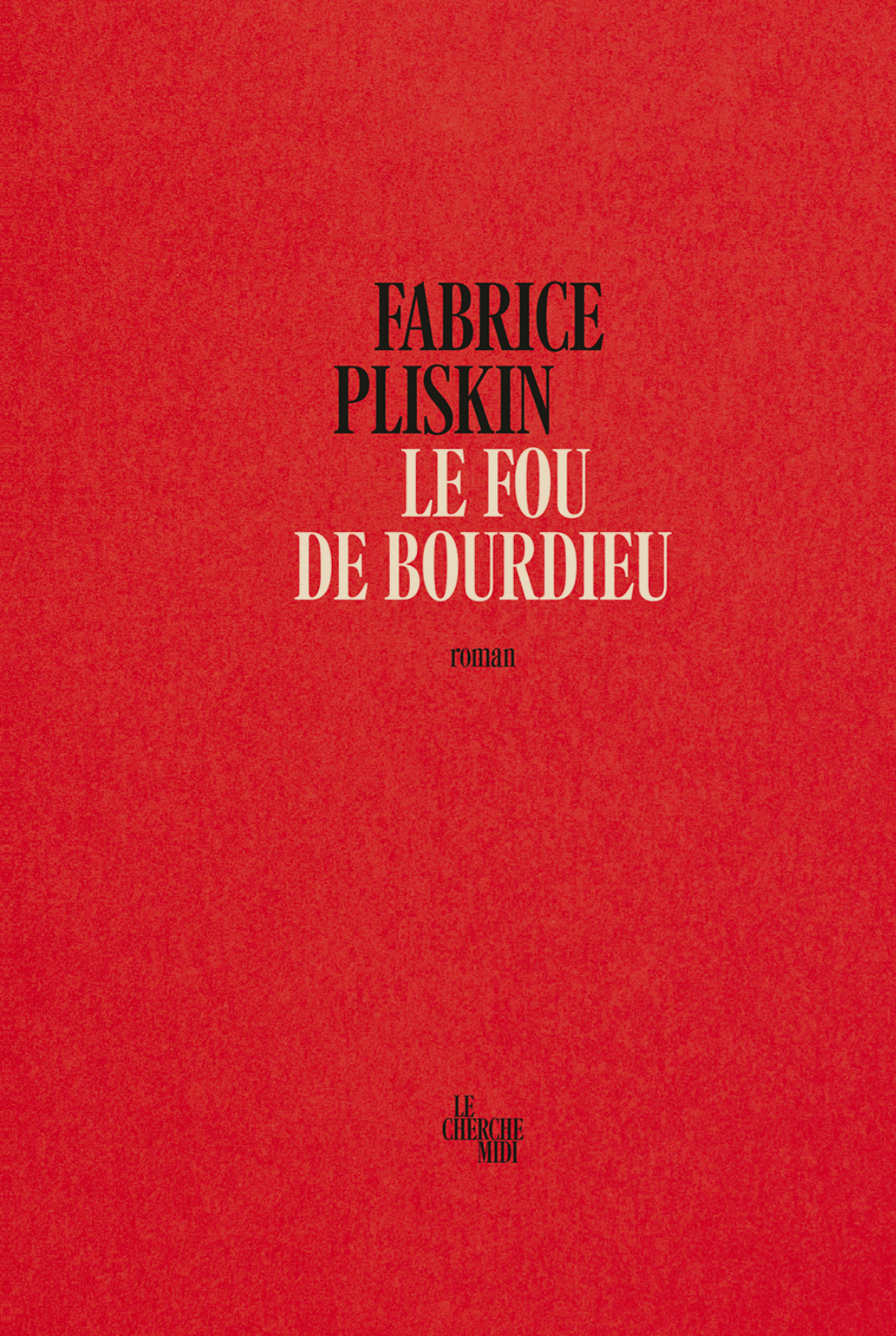
“In itself,” wrote French Romanian philosopher Emil Cioran in his book A Short History of Decay, “every idea is neutral, … but man animates ideas, projects his flames and flaws into them; impure, transformed into beliefs, ideas take their place in time, take shape as events: the trajectory is complete, from logic to epilepsy … whence the birth of ideologies, doctrines, deadly games.” It is precisely this projection of flames and passions that tends to grow into deadly games that is the subject of French writer Fabrice Pliskin’s new book Le Fou de Bourdieu (Bourdieu’s Madman). I must confess that, until reading about the book in Le Monde, I knew very little of Pliskin or his literary output. I don’t think any of his books have been translated into English. Hard as I tried to find anything by him in English on Amazon, I was unsuccessful, but I really hope this one at least will be. It certainly deserves to be more widely read.
As the title suggests, it has something to do with the renowned French sociologist Pierre Bourdieu, whose works have shaped not just the academic discipline of sociology for the last five decades or so, but have also had an oversized influence among policymakers and all sorts of political activists, from militants to peaceniks. And not just in France. To wit, I am reminded, for instance, of Russian Armenian social historian Georgi Derluguian’s book Bourdieu’s Secret Admirer in the Caucasus, which recounts, among other things, the life and fate of a Chechen professor of sociology, indeed an admirer of Bourdieu, who traded a typewriter for a Kalashnikov to fight against Russian troops during the First Chechen Campaign in the 1990s. While the character in Derluguian’s book sounds like fiction, it isn’t, being very much one of those stranger than fiction tales. Pliskin’s book, on the other hand, is fictional, though the immediacy of the text makes one feel trapped inside an extravagant prank produced by Nathan Fielder for HBO.

Centered around the character of a former jeweler, Antonin Suburre, née Firminy, from the southern French town of Brioude, it is a stinging social commentary satirizing, confronting, and confounding our borrowed wisdoms, inch deep ideological commitments, and shallow beliefs that we constantly use as escape hatches when escape becomes the only alternative to admitting intellectual defeat. Recalling Cioran’s comment above, it is, in short, a book about the dangers of having little knowledge and thinking it big. It recalls also Alexandre Kojève’s impish quip, “Human life is a comedy. One must play it seriously.”
Suburre is an unassuming jewelry shop owner leading an unassuming life, whose life takes a tragic and violent turn after he kills one of two young Arab robbers fleeing the scene of their crime on a scooter. While he amasses tremendous support on social media for his vigilante justice, it is not enough to spare him prison time. Condemned to spend the next eight years of his life in a prison full of career criminals and miscreants, with a constant glance over his shoulder for fear of a vendetta, Suburre embarks on a path of tortuous self discovery by spending time in the prison library, first seeking consolation in the arms of philosophy, then deeming it a “bitch,” (“La philosophie ? Une salope, se dit Suburre …), in a subversion perhaps of Boethius’s portrayal of philosophy as a lady personified. Neither Descartes, Spinoza, nor Kant comes to his rescue. For his present circumstances, philosophy proves to be an inadequate and feeble explanatory framework, neither here nor there. Indeed, it is a bottle of lukewarm water that, while it keeps you hydrated, does little to quench your thirst.
What comes to the rescue instead is sociology, and one of its celebrated high priests, Pierre Bourdieu, whom Suburre encounters on the pages of La sociologie pour les nuls, a kind of Sociology for Dummies, and then in visions and dreams. The encounter with Bourdieu, however, is only the first step in Suburre’s radicalization, the details of which he writes down painstakingly in his diaries. Inspired by Bourdieu and the latter’s concept of symbolic violence, Suburre comes to the conclusion that “We do not have a choice between violence and nonviolence. We have a choice between the violence of the dominant and the violence of the dominated.” (Nous n’avons pas le choix entre la violence et la non-violence. Nous avons le choix entre la violence des dominants et la violence des dominés.)
After being released from prison and befriending a young Arab doorkeeper in his apartment building who coincidentally shares the first name of his victim, Chamseddine, Suburre sets out to test Bourdieu’s ideas against the grain of the real world, but not before convincing his new friend of the inevitability that the anger sedimented in the latter’s muscles will eventually explode (la colère sédimentée dans vos muscles finisse par éclater), and perhaps his own. If in act one Suburre is the accidental killer, in act two we see his Ovidian metamorphosis from an upstanding citizen, indeed a victim of unfortunate circumstances, into Kojève’s comedian who has decided to act seriously and master the circumstances rather than become their unwilling subject. A kind of neo-Raskolnikov with a sidekick and lines of cocaine. I’ll let the reader discover whether Suburre succeeds in his existential enterprise.
★★★★☆